

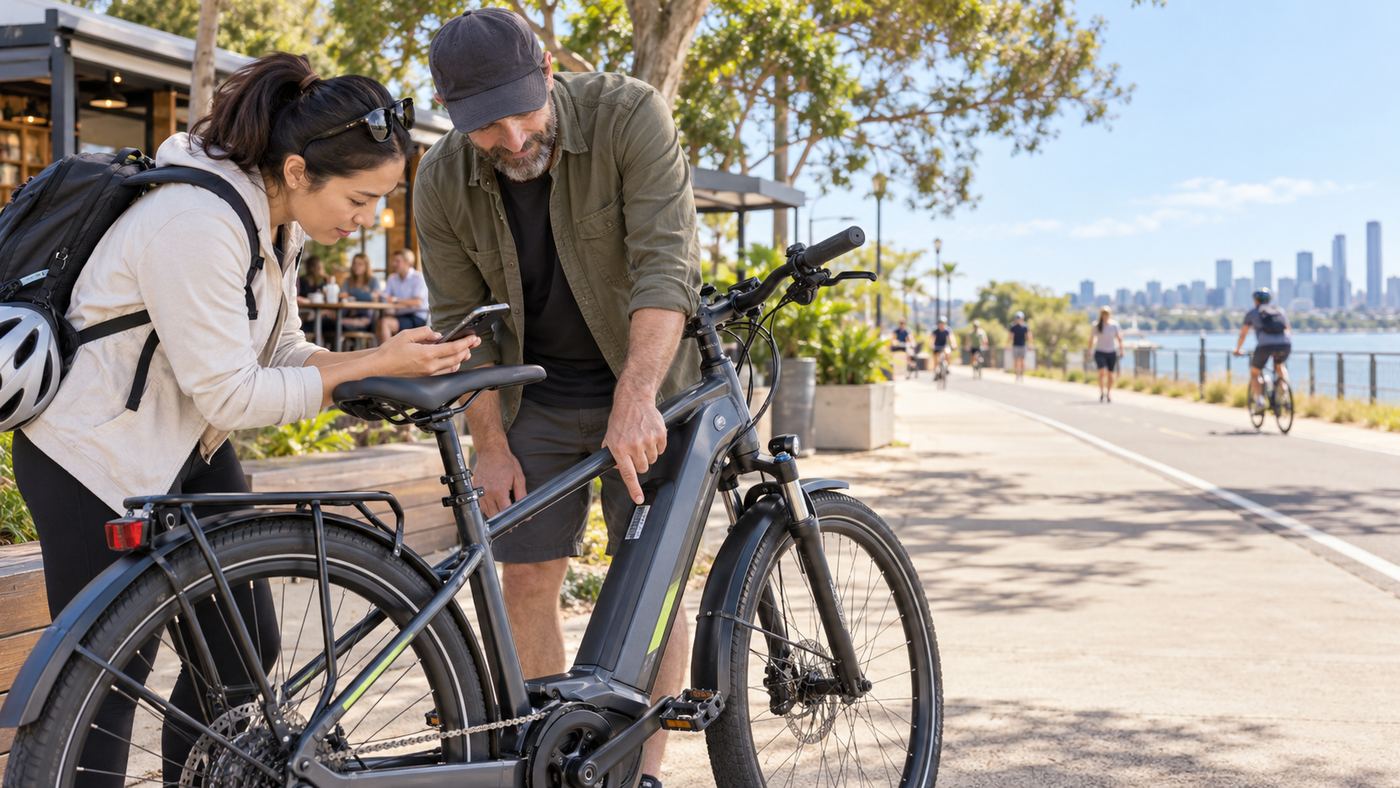
A good used e-bike can save you thousands. A bad one can cost you a battery — the most expensive part of the bike. Take this list with you.
- Step 1: Check the serial number. It is usually stamped under the bottom bracket, where the cranks meet the frame. Check it matches the ad, then check it on the EbikeMate register. If it has been ground off or scratched out, walk away.
- Step 2: Battery health. Ask for the battery make, model, serial, age, charging history and a dated maker or dealer diagnostic. Record the source, method and reference capacity of any reading. A percentage alone does not prove a battery is safe or predict its remaining life. Check damage, modification, overheating and recall status, and confirm the manufacturer-recommended compatible charger. Arrange a professional check if evidence is missing — battery evidence and safety and replacement costs.
- Step 3: Kilometres. The odometer is on the display. Compare it to what the seller told you.
- Step 4: Ride it in every assist level. The motor should pull smoothly with no grinding, clicking or cutting out. Try the throttle if it has one — it should stop helping at walking pace.
- Step 5: Brakes. Squeeze each lever hard: it should feel firm, not spongy, and stop the bike quickly. Look at how much pad is left.
- Step 6: Chain and gears. A worn chain on an e-bike wears out the cassette and chainring fast. A shop’s chain checker tells you in seconds.
- Step 7: Look for damage. Cracks near welds, dents in the down tube (where the battery sits) and bent derailleur hangers. Any crack in the frame is a no.
- Step 8: Charger, keys and accessories. Use the supplied or manufacturer-recommended compatible charger; a plug that fits is not enough. Most batteries lock with a key. A missing charger can cost $150 or more to replace.
- Step 9: Compliance label. In Queensland an e-bike ridden in public needs an EN 15194 or Legacy EPAC label from 1 March 2027. Read about the rules.
- Step 10: Paperwork. Ask for the receipt and any service records — no history means budgeting for a service soon (what a service costs). Pay at handover — never a deposit by bank transfer, gift card or crypto.
Meeting the seller
- Meet in daylight, somewhere public.
- Bring a friend if you can.
- Ride it somewhere safe, away from traffic.
- If the price looks too good to be true, it usually is.
Buying through Facebook Marketplace or Gumtree? Read how to buy a used e-bike on Facebook Marketplace safely.
Common questions
What should I check before buying a used e-bike?
The frame serial (and check it on EbikeMate), battery health, kilometres, a test ride in every assist level, brakes, chain and gears, frame damage, charger and keys, the compliance label, and the receipt or service records.
What battery health is good on a used e-bike?
Ask for a dated maker or dealer diagnostic, its method and reference capacity. Compare usable capacity and expected range with your needs. A percentage alone does not prove a battery is safe or predict its remaining life. Check the battery and manufacturer-recommended compatible charger for damage, modification, overheating and recall status before paying.
Should I pay a deposit to hold a used e-bike?
No. Pay at the handover, and never pay a deposit by bank transfer, gift card or crypto.
Sources
- Lithium-ion batteries guide — ACCC Product Safety
- Second-hand e-micromobility and battery safety — NSW Fair Trading
- Lithium-ion battery-operated equipment — Queensland Electrical Safety Office
- Dealer battery capacity and diagnostic checks — Bosch eBike Systems
This guide explains things in general terms. It is not legal advice. Spotted something out of date? Tell us.